Transport ICT and safety systems for metro, rail and airports, connected and always on
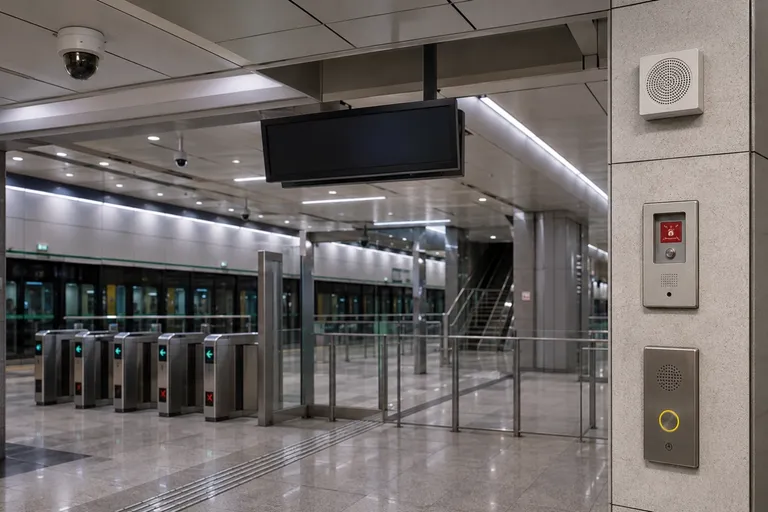
You run a facility that never really closes. A network outage at peak hour, a camera blind spot on a platform, or a voice alarm that misfires in a packed terminal is not an inconvenience, it is a public-safety event. Transport ICT solutions are the networks, surveillance, building controls, passenger information and life safety systems that keep a metro station, railway hub or airport terminal safe and moving, and you get them designed, integrated and certified together under one contract.
Metro rail safety readyNFPA 72 (2022) · EN 54TIA-568-D (2018)One contract, fully certified
Honest scope
What we sell, and when we are not your best option
Yakkaservices integrates the building systems behind a transit facility. Here is where that work fits, and where it does not, so you can place us correctly before you read another word.
When we are the right fit
When a metro station, depot, railway hub or airport terminal needs several systems designed, integrated and certified together, and when you want one team accountable for how the network, cameras, controls, announcements and fire systems behave as a whole.
When a specialist contractor fits better
We do not supply or maintain rolling stock, signalling and train control (CBTC), trackwork, platform screen door mechanics, or baggage handling machinery. If your scope is one of those alone, a dedicated specialist is the right call, and we will tell you so.
When you want a software vendor
If you need a ticketing application, a journey-planning app, or an intelligent transport system (ITS) software platform on its own, that is a software procurement. We integrate the field networks and devices these platforms run on, but we do not write the application.
Why public transport is different
What makes public transport systems different
A transit hub never stops
Your busiest hour can carry many times your average load, and the systems have to hold at that peak, not at the average. There is rarely a quiet window to take a network, a camera ring or a fire panel offline, so design for live maintenance and redundancy is a starting condition, not an upgrade.
Rules other buildings do not carry
A metro or rail facility answers to fixed-guideway fire and life safety rules, and authority sign-off from the metro rail safety regulator before passenger service begins. An airport adds aviation security and restricted-zone control. These codes govern evacuation, ventilation, voice alarm and access in ways a normal commercial building never sees.
Evacuation moves a crowd, not a person
When something goes wrong you are clearing a packed platform or concourse, not walking a few people to an exit. That puts weight on voice alarm intelligibility, smoke control across large volumes, and announcements and signage that direct a crowd the same way at the same moment. A message that is unclear or out of step costs you the evacuation.
Critical systems
The systems that keep a transit facility running
Transport ICT solutions are not one product. They are six systems that have to be designed to work as one, each carrying a different part of keeping your facility safe, secure and moving.
Network & structured cabling
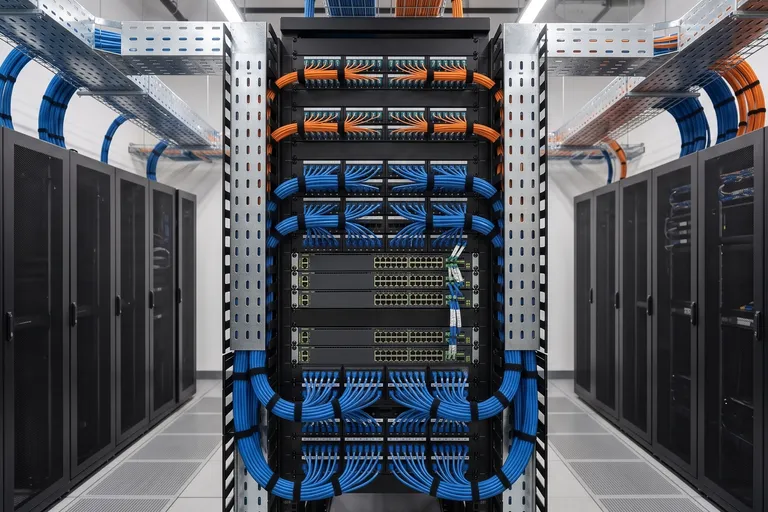
The data backbone every other system rides on, from ticketing and passenger information to CCTV and building controls. Designed for resilience and growth to TIA-568-D (2018) and ISO/IEC 11801:2017, with operational traffic separated from corporate so a public-facing fault cannot reach your control network.
Platform, concourse and perimeter CCTV feeding one control room, with storage sized to the retention period your authority mandates. Camera placement comes from a site survey, not a template, so the coverage you pay for is the coverage you get.
Controlled separation between public areas, paid zones, staff-only spaces and, in an airport, landside and airside. Access events tie back to the surveillance and command platform, so an alarm shows you the door and the camera together.
HVAC, lighting and energy controls for stations and terminals on open protocols (BACnet, Modbus, KNX), with the interfaces to station and tunnel smoke control that fire and life safety depend on. Open protocols keep you free to change or extend without returning to one vendor.
Addressable fire detection across a distributed site, integrated with voice alarm, smoke control and access release so a single event triggers one coordinated response. Designed to NFPA 72 (2022), NFPA 130 and local fire authority requirements.
Public address, voice alarm, digital signage and wayfinding that handle routine announcements and switch to a clear, zoned evacuation message when fire and life safety calls for it. Voice alarm built to EN 54-16 and EN 54-24 for intelligibility under load.
Where transit systems go wrong, and how the failure is prevented
Four failures that show up at commissioning or after the facility opens. Each one is preventable at design stage.
01Failure 01
A voice alarm a packed platform cannot make out
The speakers pass on a bench test, but nobody checks intelligibility in a live concourse with trains arriving and a crowd talking over them. On a transit platform, a voice alarm that cannot be understood under that noise is a message that does not land at the one moment it has to. We have seen systems specified by speaker count alone, with no intelligibility target anyone measured.
Consequence
An evacuation message lost under crowd and train noise, the one moment it has to be understood.
Prevention
Voice alarm designed for intelligibility to EN 54-16, zoned to match the space, and measured against a speech-intelligibility target at commissioning, not assumed from the speaker count.
02Failure 02
Camera blind spots, or storage undersized for retention
Cameras get placed to the drawing rather than the sightlines, so a pillar or a standing crowd creates a blind spot exactly where an incident happens. The recorder is sized to a round number of days instead of the retention your authority mandates, and the footage you need has already been overwritten.
Consequence
An incident on a platform or concourse with no usable footage, and a retention gap your regulator can cite.
Prevention
Coverage modelled from a site survey against sightlines and crowd flow, with storage sized to the mandated retention period and verified at commissioning, not estimated on a datasheet.
03Failure 03
A network with a single point of failure at peak load
Ticketing, fare collection, passenger displays and CCTV all share one backbone, and that backbone has one path. It holds in testing at low load, then a switch or a link fails during the evening peak and several passenger-facing systems drop at once.
Consequence
Ticketing, fare collection and passenger displays go down together at the busiest hour, when you can least absorb it.
Prevention
A resilient backbone with redundant paths and failover, operational traffic separated from corporate, tested under simulated peak load before handover.
04Failure 04
Access zones that leak between paid, unpaid, landside and airside
The access design follows the architecture rather than the operational rules, so a service door or an interchange route quietly bridges a paid and unpaid area, or in an airport a landside and airside boundary. It works for staff on day one and becomes a fare-evasion path or a security finding later.
Consequence
A fare-evasion route, or in an airport a security breach and a regulatory finding against your restricted-area control.
Prevention
Zoning designed from the operational plan, access tied to surveillance for event correlation, and every boundary door tested against its rule set before the facility opens.
Integration
How the systems connect in a transit facility, and why that is the hard part
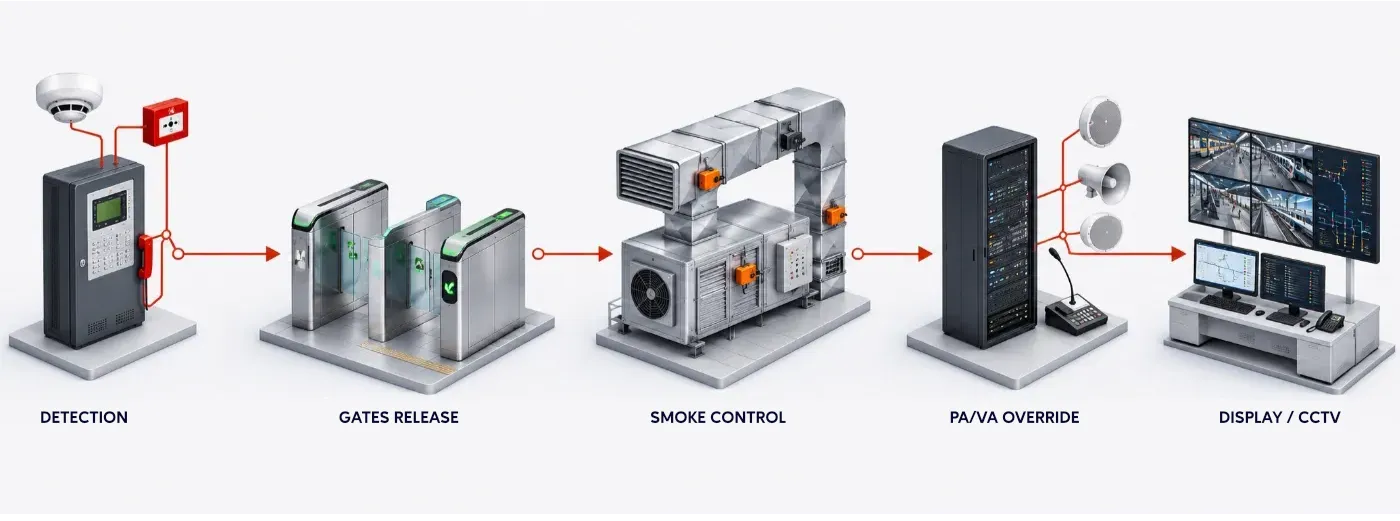
In a transit facility, the systems are only as good as the points where they meet. A safe evacuation depends on fire detection, smoke control, access, announcements and displays acting as one. None of that happens by accident. It happens because the interfaces were drawn at design stage and tested before handover.
One integrated response to a single event
Fire event detected
Access gates and doors release
Smoke control and ventilation start
Escalators and lifts to safe mode
PA and voice alarm override
Displays and control room direct the crowd
When one team designs and commissions all of it under a single contract, those interfaces are one team's responsibility. When each system is a separate contract, the gaps between them belong to no one, until the day they fail.
In a transit facility
One integration partner
Single contract
Multiple specialist contractors
Separate contracts
Cross-system interfaces
fire→gates, fire→smoke control, CCTV→access
Designed and tested by one team
Fall between contracts, surface at commissioning
Cause-and-effect evidence for inspection
One party presents it
Each contractor points to the next
Authority and safety handover pack
Assembled as one package
Fragmented, gaps found late
Phasing around live revenue service
One coordinated plan across systems
Each crew schedules around its own work
After handover
One support contract across systems
Separate contracts, disputed faults
Compliance and authority requirements
The compliance we own, by system
Compliance is easier to judge when you can see it by system. Here is what each system we deliver is designed, tested and approved against, for transit projects in India and Oman.
The network everything else runs on
Structured cabling and the data backbone that carries ticketing, passenger information, CCTV and controls, designed for resilience and growth.
Authority approvalTest certification at handover
Designed, tested & certified to
TIA-568-D (2018)
Structured cabling design and performance
ISO/IEC 11801:2017
Generic cabling for customer premises
IEC 60364
Low-voltage electrical installations
Across all of them, you receive the evidence at handover: test certificates, the fire cause-and-effect matrix, voice-alarm intelligibility results, and as-built drawings.
FAQs
Transit systems: questions buyers ask us
The questions transit authorities, operators, and consultants ask before they specify.
A transit facility needs the physical infrastructure that operations and passenger systems run on. That includes the network and structured cabling, surveillance and access control, building management and ventilation, addressable fire and life safety, and public address with voice alarm. Signalling, rolling stock and the ticketing application sit beside or on top of this layer. We deliver the integrated systems layer, not those specialist scopes.
By designing the network for the peak hour, not the average, with redundant paths and failover so no single switch or link takes several systems down at once. Operational traffic is kept separate from corporate, so a public-facing fault cannot reach your control network. The backbone is tested under simulated peak load before handover, not assumed to scale.
Through one coordinated response that fire detection triggers and the other systems carry out. Detection releases access gates, starts smoke control and ventilation, moves escalators and lifts to safe mode, and switches public address to a zoned voice-alarm message. The logic is written into a cause-and-effect matrix and proven in an integrated test before the authority visit, not assumed.
Fire and life safety follow NFPA 72 (2022), NFPA 130 for fixed-guideway transit, and EN 54 for components, with voice alarm to EN 54-16. In India, a metro project needs sign-off from the Commissioner of Metro Rail Safety and the state fire authority; in Oman, from the Royal Oman Police Civil Defence. Airports add aviation security requirements under ICAO Annex 17.
Yes, and on a transit project we expect to. We take the integrated building-systems scope and coordinate our interfaces with the civil, trackwork, signalling and rolling-stock packages run by others. Defining those boundaries early is part of the assessment, so nothing falls between our scope and theirs at commissioning.
As early as the design stage, while the consultant is still setting the systems scope. Early involvement lets the cross-system interfaces, evacuation logic and network resilience be designed in rather than corrected on site later. If the project is already under construction, an integrator can still take it over, but the earlier the interfaces are agreed, the fewer surprises at commissioning.
Book a transit systems site assessment
A clearer scope for your transit project, whether or not you work with us
Tell us about your metro, rail or airport project and a senior engineer reviews it with you, then sets out what your systems need and where the risks are.
An engineer who has delivered transit systems contacts you, not a salesperson
You get a response within one business day
No cost and no obligation for the assessment
If a single specialist contractor is the better fit, we will say so
Tell us about your transit project
Response within one business day. No cost, no obligation.